
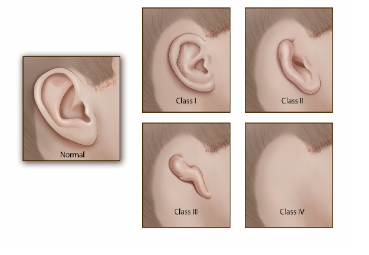
Microtia occurs when the ear does not fully develop during the first trimester of pregnancy
This leaves the child with small, underdeveloped ears, or in some cases, no external ear at all
One in every 9,000 children is born with microtia
There are four classes of microtia:
Absence of a normal ear canal prevents sound from being effectively transmitted to the inner ear,
leading to a conductive hearing loss on the affected ear
Treatment Options:
1) Ear Canal Surgery:
An Atresiaplasty procedure consists of drilling behind the bone behind the microtia to
create an ear canal. After a canal is drilled, skin graft is placed to line the canal and
eardrum. Risk factors of this procedure include narrowing of the ear canal and damage to
the facial nerve.
2) Bone Conduction Hearing Aid (Non-Surgical):
Children ages 5 and younger who are not of implantable age, or for those who do not
wish to undergo surgery, can use a hearing processor that is attached to a headband. The
device works via vibration, in which sound causes the skull to vibrate, allowing the
individual to hear through bone conduction.
3) Bone Anchored Hearing Apparatus (BAHA):
A BAHA bypasses the outer and middle ear and stimulates both cochleae via bone
conduction. It consists of a metal abutment that is surgically implanted into the patient’s
skull, and an external piece that snaps on. A risk factor for this option is that it has a
higher infection rate, since the abutment site requires thorough hygiene.
4) Osia Implantable Device:
The Osia implantable device is similar to a BAHA, as it bypasses the outer and middle
portions of the ear to stimulate the cochlea via bone conduction.With the Osia device, an
internal implant is drilled into the mastoid bone, and an external processor connects to the
internal piece via magnet to stimulate both cochleae. This device requires less hygienic
maintenance, but is not ideal for someone who undergoes frequent MRIs as it can cast a